

A woven scarf ends in loose threads rather than a single continuous line. Textile photographers separating that scarf from its shooting surface need to preserve the distinction between dense fabric, individual fibers, and the spaces between them. Product background removal reaches its most demanding local decisions where those three regions meet. The finished asset needs an edge that still reads as the photographed textile, rather than a smooth replacement outline.
Alpha matting addresses partially transparent transition pixels around a subject. Its role is examined through the scarf’s fringe, where a pixel covers a mixture of fiber and surroundings. This is separate from choosing the scarf’s overall position in a layout. Understanding that local transition gives photographers a useful basis for reviewing the result without treating every pale edge pixel as either unwanted background or solid thread.
What Alpha Matting Adds to Product Background Removal
An image pixel at the middle of a broad woven panel represents a different situation from a pixel at the side of a thin fiber. Near that fiber, the recorded sample contains contributions from both subject and surroundings. Alpha describes how strongly the exported pixel participates when the image is placed over another surface.
An intermediate value creates a transition rather than a wholly opaque edge.
Textile photographers assess product background removal through that material relationship. A fine thread does not need the same boundary appearance as a dense folded hem. Matting concerns the transition around the recorded subject, including partly transparent edge pixels. It is not a description of new threads or a substitute for detail in the source photograph. The original remains the evidence for the fringe’s structure and direction.
Begin with Fibers That the Photograph Actually Records
Before reviewing calculated transitions, textile photographers examine focus and exposure at the ends of the scarf. A sharp woven center does not establish that the fringe lies within the same plane of focus. If the thread ends blur into the shooting surface, their width and separation are uncertain in the source itself. Another photograph addresses that uncertainty before the asset enters layout preparation.
Product background removal also depends on the available contrast around pale fibers. The reviewer traces a thread through its stronger and weaker portions rather than using a single bright patch to judge the whole strand. A highlight along the yarn belongs to the material, while the surrounding surface occupies the gaps. This source reading establishes the reference needed for a later assessment of transparency along the exported edge.
- Examine focus at the actual ends of the fringe
- Distinguish yarn highlights from spaces between neighboring strands
- Retain a source view with complete thread tips
- Compare dense hems separately from sparse outer fibers
- Review transparency against contrasting surfaces outside the original scene
Follow the Transition from Source to Exported Edge
The processing starts with the photographed textile, separates the subject, and refines its edge transitions through alpha matting. PNG output from a product image background remover retains the resulting transparency. When that asset is placed on a new surface, the partially transparent edge pixels blend with the new surroundings according to their alpha values.
The source scene and the destination surface therefore have different roles in the review.
Textile photographers inspecting product background removal follow a small group of fibers through this sequence. Their positions and spacing come from the original; their transition onto a new surface is assessed in the export. A pale halo that accompanies the fringe across several destinations deserves a different interpretation from a thread that genuinely catches light. Comparison with the photographed yarn establishes which explanation fits the local structure.
Assess Product Background Removal through Material Transitions
Alpha matting is part of the processing, while profile choice addresses the broader character of the subject. The detail profile concerns fine structures such as fringes and thin material ends. Textile photographers compare that choice through the scarf’s recorded fibers, looking for preserved thread tips and appropriate empty spaces rather than assuming that a profile name confirms the result.
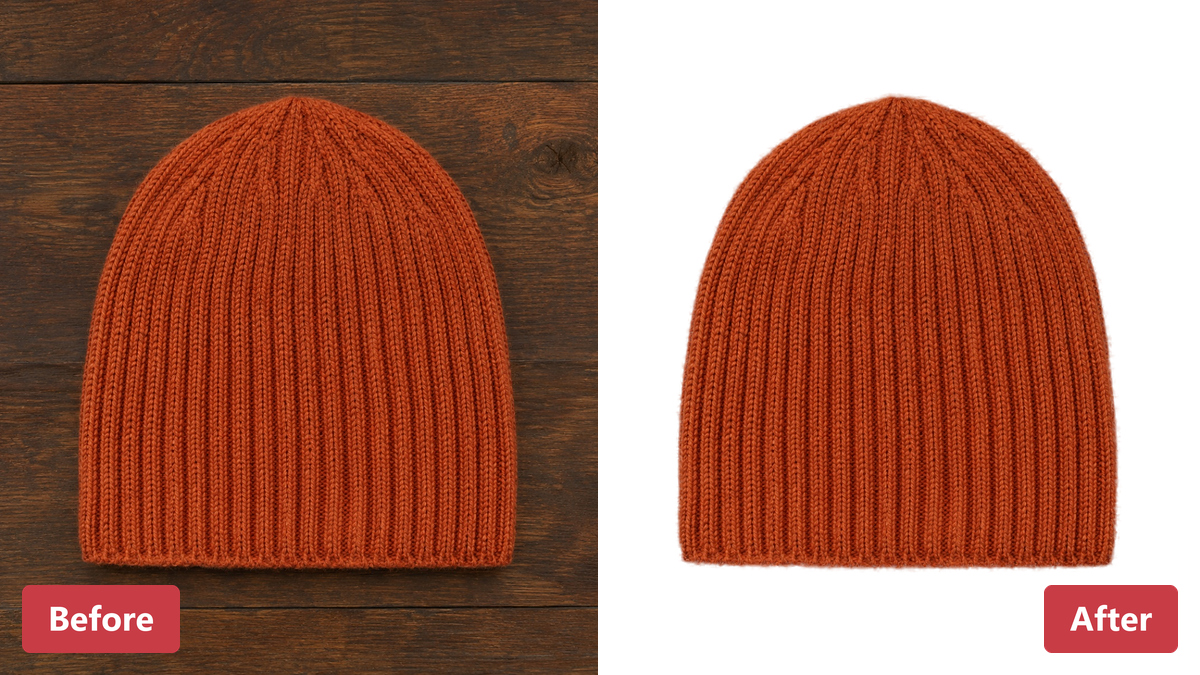
The review of product background removal remains an observation of the exported file. Processing decisions are linked to the features present in the source, and changes are assessed against the same locations. A dense hem and an isolated yarn end are useful paired references because they need different edge appearances. The aim is material fidelity across those regions, without imposing a uniformly hard contour on a textile whose actual boundary is irregular.
| Starting Material | Transition Effect | Result to Inspect | Textile Use |
|---|---|---|---|
| Single pale yarn against a dark surface | Mixed edge pixels retain intermediate opacity | Fine strand meets a new backdrop without a solid rim | Scarf end shown beside dark typography |
| Dense folded hem with defined stitching | Subject interior remains distinct from its perimeter | Seam retains the photographed fabric width | Weave detail in a material sample sheet |
| Loose tassel separating into several ends | Transitions follow individual terminal structures | Empty intervals persist between recorded tips | Accessory detail in a retail brochure |
| Crossing threads above the shooting surface | Opacity varies around overlapping fiber edges | Intersection remains joined where the yarn crosses | Close view for a textile collection record |
| Soft pile extending beyond a woven panel | Gradual boundary treatment follows the material extent | Outer softness differs from a cut fabric edge | Texture emphasis within a sample presentation |
| Dark fringe beside a pale woven body | Separate local transitions meet different subject tones | Terminal yarn and panel remain visually related | Whole scarf asset on an interchangeable surface |
Compare the Edge on More than One Surrounding Tone
A transition that disappears against a pale surface becomes easier to judge against a darker one. Textile photographers place the exported asset over contrasting layout surfaces to examine that change. This is a review of the asset in another application or layout context, not a claim that a new background corrects an inaccurate edge. The source comparison still determines what the textile contains.
Product background removal passes this examination when fibers remain connected to the fabric and their transitions behave plausibly in the chosen presentation. Small gaps are checked at the final display size too. Reduction changes the separation between a retained thread and its neighbor in the displayed image. That display outcome influences layout size, while the enlarged comparison addresses the integrity of the retained fringe.
Examine the Calculated Edge after Product Background Removal
The software includes alpha matting for refining partially transparent subject edges and a detail profile for fine structures. Textile photographers examine the returned cutout alongside the original, then retain PNG transparency when the asset needs to meet different layout surfaces. Processing takes place locally, without sending the photographs away for the separation step.
At a pale thread tip, product background removal involves a transition between yarn and surroundings rather than a simple decision about a broad empty area; this is where the exported edge receives close attention. The application also writes results apart from the originals, maintaining the source reference for later discussion. A completed fringe review identifies which structures remain intact and which destination conditions were examined, giving the layout handoff a more useful basis than a general statement that the scarf looks isolated.
Preserve the Textile Character in the Accepted Asset
Acceptance rests on the relationship between the woven body and its loose ends. Textile photographers retain a version whose edge describes that recorded structure, then assess it at the size required by the presentation. The fringe is neither forced into the contour of a solid panel nor treated as a separate decorative effect. Product background removal has completed its local task when the exported transitions preserve the material evidence and meet the chosen surface without carrying an unexplained rim. The original photograph remains available for questions about individual fibers, while the reusable asset carries the transparency needed for its next layout placement.